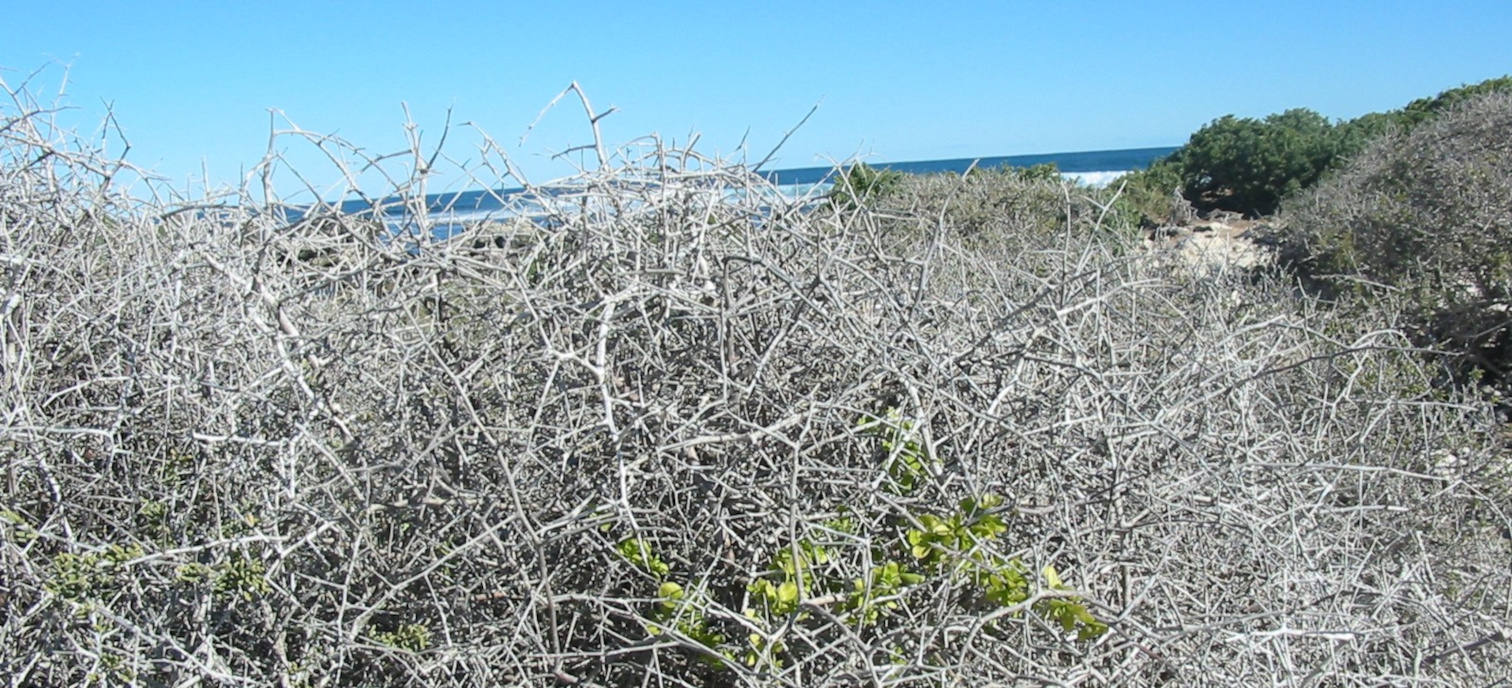

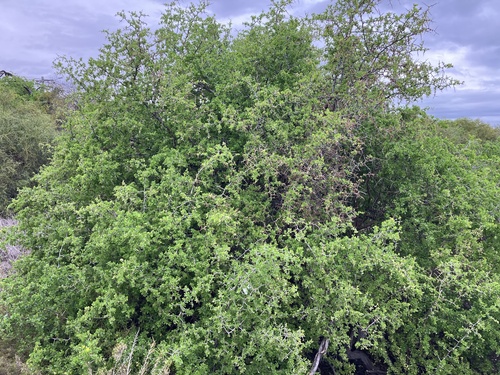
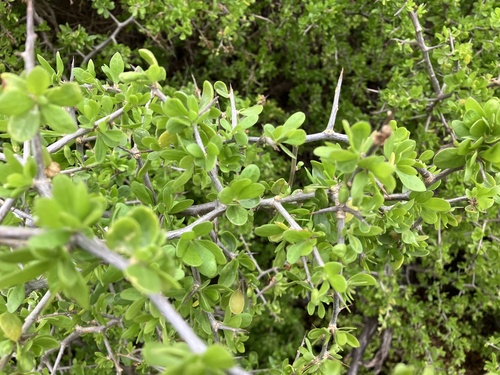
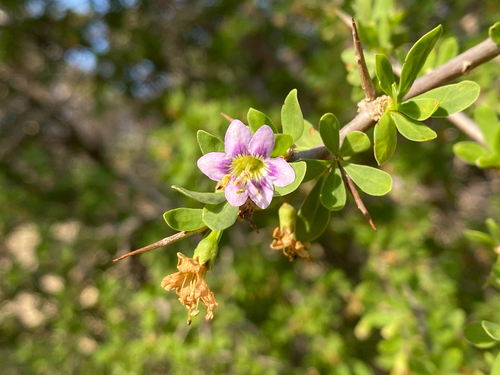
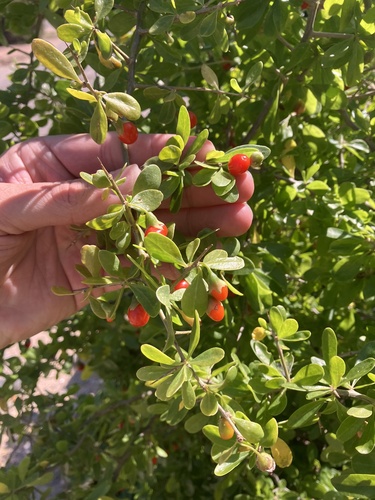
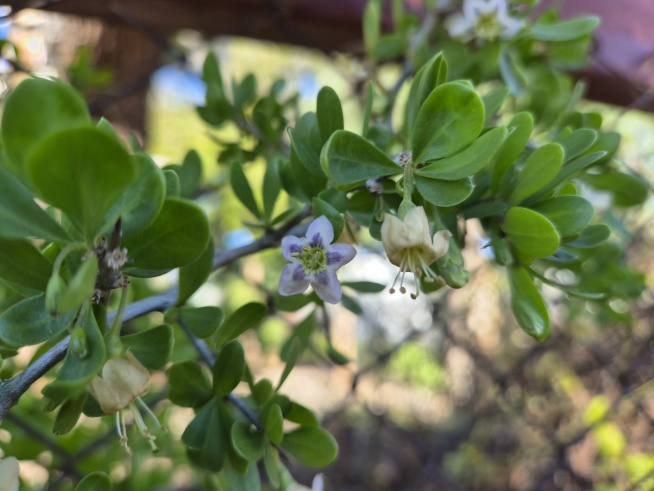
A large dense woody shrub with small evergreen leaves and with long thorns that form impenetrable thickets. Commonly found in disturbed areas; farmland, waste sites etc. Particularly abundant in high rainfall areas or found closer to permanent water sources in drier environments (Haegi 1976). Tolerant of most soil types (including some degrees of saline areas). African Boxthorn is generally found in cool to warm temperate areas, subtropical, semi-arid and arid to sub-humid areas (Navie 2004), and is common in all but the northern tropical parts of Australia (Noble and Rose 2013).
Boxthorn
Lycium ferocissimum
Quick facts

Status
Permitted s11

Life cycle
Perennial

Growth form
Shrub/Tree

Origin
South Africa

Flowers
White to pale lilac

Dispersal
Bird, mammals, garden waste

Toxicity
All parts
Form and function

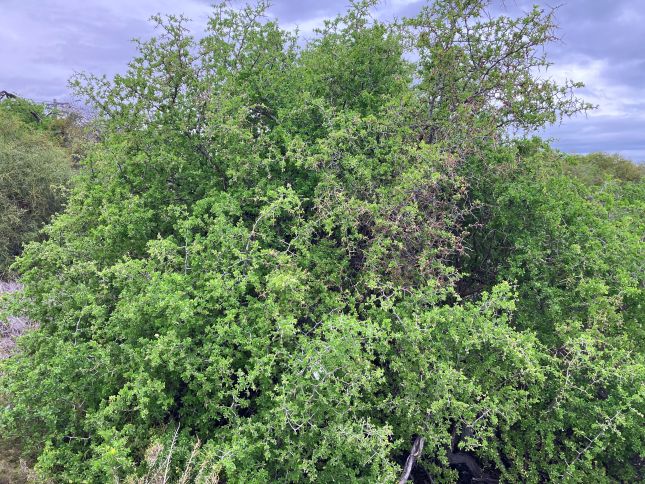
Flowers
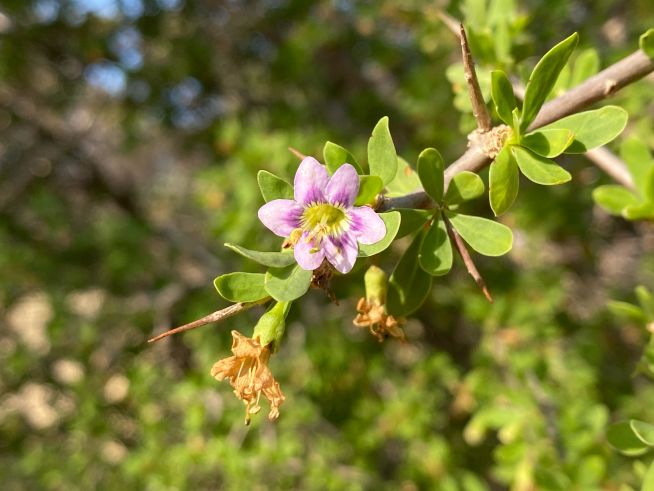
Leaves
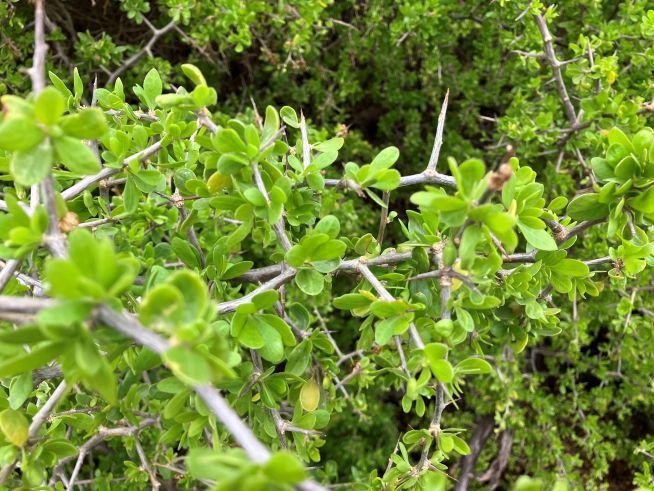
Fruits
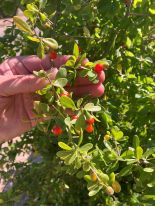
Roots
Why is it a weed?
How does it spread?
What is its history in Australia
How to control


Physical control
Physical control should be carried out when there is no or minimal seed on the plant. Boxthorn is deep rooted so considerable effort is required to physically remove boxthorn. For large plants winching and pulling of boxthorns offer least disturbance of the mechanical methods, however chemical control is necessary to treat regrowth from strong root systems.
Large plants
- Winching: using rigging at the base of plant connected to a consistent force e.g. vehicle to pull plant out and as much of the root system as possible.
- Pulling: using a front-end loader, articulated loader or excavator to pull out entire plant and as much of root system as possible using hydraulic arms attached to the front of machinery. A hydraulically operated puller has been commercially developed specifically for the removal of African boxthorn.
- Bulldozing, stick raking and blade ploughing should be used in more disturbed areas where the surrounding environment is less sensitive. This is a rapid control method and is suitable for moderate to heavy infestations.
Small plants
- Seedlings can be hand pulled in soft soil to ensure complete root system is removed.
Chemical controls
Foliar sprays to be applied in active plant growth in spring or post rain, monitoring and follow ups are essential for effective control and suppression of boxthorn, this is best done in autumn. Boxthorn sheds its leaves when stressed so foliar spray is not the most reliable control method. All foliage must be covered during application.
Foliar spray in 100L of water - 1L Glyphosate (450g/L) + 10g metsulfuron-methyl (600g/kg).
Basal bark: around the base of stems when the plant is a maximum of approx. 50mm in diameter and a height of 30-40cm above ground level. Treat with a mix of triclopyr (600g/L) at a rate of 2L/60L of biodiesel (Department of Environment and Water, 2024).
- Triclopyr, along with triclopyr–picloram-based herbicides (mixed with diesel)
Cut and swab: cut each stem at ground level (no more than 15cm above ground) and apply herbicide to the cut stem immediately (can be sprayed or painted). Apply a 3-5mm thick layer of gel to freshly cut stump. Noble et al (2021) lists the following herbicides and mixes and states that this method is best for when faced with poor vehicle access areas, and allows dead boxthorn debris to be removed which reduces invasive fauna habitat and protects native fauna, humans and vehicles (ridding thorns).
- Triclopyr–picloram mix (in diesel),
- Triclopyr (mixed with diesel),
- and picloram are suitable for this technique.
- Glyphosate (mixed 1:1 with water) has been used successfully with the cut stump technique over many years by Friends of Bass Strait Islands (Ziegler and Hopkins 2011).
Root application: when the soil is wet or rain is expected (Land Protection 2006), apply a residual herbicide to the soil between the base of the plant and the drip line. Do not use this technique in environmentally sensitive areas. Only suitable in highly disturbed areas, where native bushland is not present.
- Tebuthiuron is applied to the soil near the drip line of the target plant
- Picloram-based herbicides can be used for stem-injection application, while glyphosate-based herbicides can be used for frilling or stem-scrape techniques (Noble and Rose 2013).
Biological control
Puccinia rapipes (boxthorn rust fungus) is a biological control agent for boxthorn. As of 2026 it's in the early stage of release trials. For more information see CSIRO Boxthorn rust fungus.
 Permit PER96570 for glyphosate
Weed Distribution Map
LSID number: [51447682] | full LSID: [https://biodiversity.org.au/nsl/services/rest/taxon/apni/51447682] | field_lsid: [] | taxon: [Lycium ferocissimum]
ALA Reference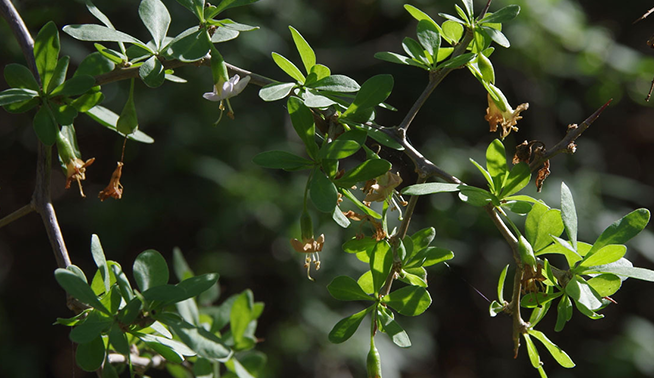
References
-
 Department of Agriculture, Fisheries and Forestry (2025).
Puccinia rapipes for the biological control of Lycium ferocissimum.
Department of Agriculture, Fisheries and Forestry (2025).
Puccinia rapipes for the biological control of Lycium ferocissimum.
-
Department of Environment and Water (2024).
Landscape South Australia Eyre Peninsula. African boxthorn (Lycium ferocissimum) Fact sheet. South Australian Government
-
Department of Primary Industries and Regional Development (2026).
Western Australian Organism List (WAOL)
-
Haegi, L. (1976).
Taxonomic account of Lycium (Solanaceae) in Australia. Australian J. Botany 24: 669-679
- Ireland KB, Hunter GC, Wood A, Delaisse C, Morin L (2019a) Evaluation of the rust fungus Puccinia rapipes for biological control of Lycium ferocissimum (African boxthorn) in Australia: life cycle, taxonomy and pathogenicity. Fungal Biol 123:811–823
- Navie S. (2004). African boxthorn (Lycium ferocissimum). Declared Plants of Australia. An identification and information system. Centre for Biological Information Technology: Brisbane
-
Noble MR, Adair RJ, and Ireland KB (2021)
Biology of Invasive Plants 2. Lycium ferocissimum Miers. Invasive Plant Sci. Manag 14: 41–56.
- Noble MR, Rose M (2013) African Boxthorn National Best Practice Manual: Managing African Boxthorn (Lycium ferocissimum) in Australia. Devenport, TAS: Tasmanian Department of Primary Industries, Parks, Water and Environment. 76 p.
-
CRC Australian Weed Management (2007)
Weed Management Guide, African boxthorn – Lycium ferocissimum
- Ziegler K, Hopkins K (2011) Furneaux Islands—Boxthorn Control. Hobart, TAS: Friends of Bass Strait Islands–Wildcare. 8 p.
Weed lifecycle calendar
| JAN | FEB | MAR | APR | MAY | JUN | JUL | AUG | SEP | OCT | NOV | DEC | Notes | |
|---|---|---|---|---|---|---|---|---|---|---|---|---|---|
| Germination |
Can germinate all year round, but mostly after rainfall
|
||||||||||||
| Flowering |
Lorem ipsum dolor sit amet consectetur adipisicing elit. Vitae, dolor.
|
||||||||||||
| Fruiting |
Regularly or most commonly
Occasionally, given suitable conditions
Not likely but conditionally dependant
Management action calendar
| JAN | FEB | MAR | APR | MAY | JUN | JUL | AUG | SEP | OCT | NOV | DEC | Notes | |
|---|---|---|---|---|---|---|---|---|---|---|---|---|---|
| Hand removal |
Hand removal of seedlings all year. Mechanical removal take note of fire risk.
|
||||||||||||
| Foliar spray | |||||||||||||
| Paint |
Or cut stump and basal bark. Follow up chemical spray the following season
|
Optimal
Potentially, but conditionally dependent
Not likely but conditionally dependant